
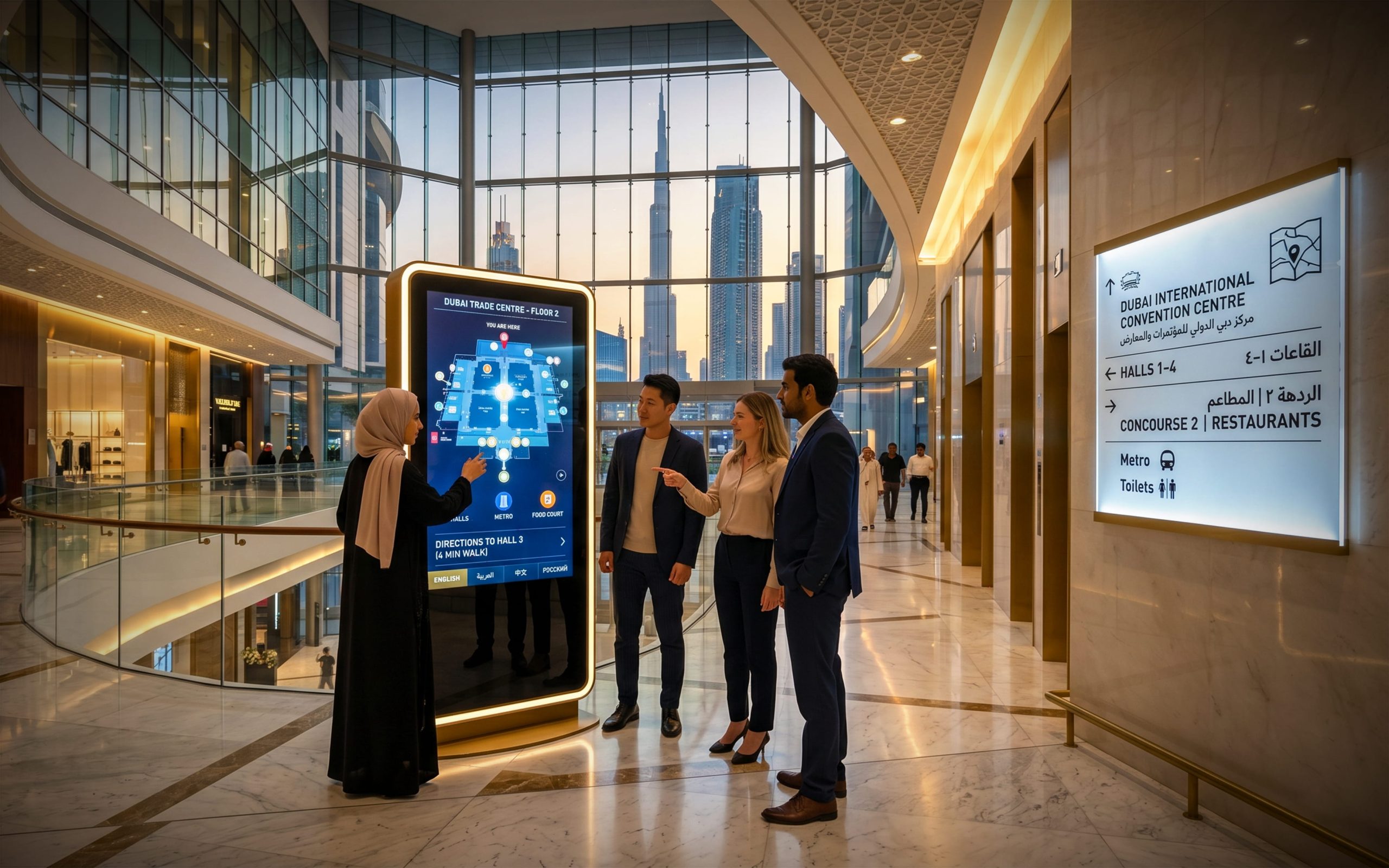
Digital Wayfinding in Modern Buildings
Supporting navigation through a combination of physical signage and digital systems
Introduction
As buildings continue to grow larger and more complex, relying only on traditional signage systems is no longer always sufficient.
In many modern developments, especially malls, hospitals, airports and large campuses, users expect faster, more intuitive ways to find their destination. Static signage does its job, but in certain environments, it reaches its limitation.
This is where digital wayfinding starts becoming relevant not as a replacement, but as an additional layer of support.
Core Idea
Digital wayfinding should not be misunderstood as “screens replacing signs”.
It is about supporting navigation using digital tools where required, while keeping the physical signage system as the backbone.
A well planned environment will always rely on clear physical navigation first. Digital systems should come in to assist:
- When information is too large
- When environments keep changing
- When user interaction is required
The mistake most projects make is jumping into digital without fixing the base navigation system.
Human Behaviour
People today are more comfortable interacting with digital interfaces. At the same time:
- They don’t want to depend on them
- They don’t want confusion
- They don’t want to “figure things out”
A user walking into a building expects:
- Basic direction from physical signage
- Additional clarity from digital tools (if needed)
If a user has to depend only on a screen to navigate, the system has already failed.
Digital should assist not control movement.
System Explanation
A well-structured digital wayfinding system typically includes:
- Interactive directories (touchscreen kiosks)
- Digital maps showing “You Are Here”
- Integration with building directories
- Real-time updates for tenants / departments
- Mobile-linked navigation (in advanced cases)
The key is not the technology it is how well it integrates with the overall navigation system.
Challenges
- Installing digital systems without clear wayfinding logic
- Over-reliance on screens instead of physical signage
- Poor content management and outdated information
- Lack of coordination between digital and physical systems
- High maintenance without long-term planning
Many projects invest in digital systems, but fail to maintain them making them ineffective over time.
Application
Digital wayfinding is most effective in:
- Shopping malls
- Hospitals and healthcare facilities
- Airports and transport hubs
- Large office campuses
- Mixed use developments
Especially where:
- Environments change frequently
- User flow is high
- Information is dynamic
RIZQ Group Approach
At RIZQ Group, digital wayfinding is approached as part of a larger navigation system not as a standalone solution.
Our focus is to ensure that:
- Physical signage works first
- Digital systems support where required
- Both systems are aligned
We work closely with project teams to ensure that digital implementation does not complicate navigation, but improves it.
Conclusion
Digital wayfinding is not about adding technology to a building.
It is about improving how people experience navigation.
When used correctly, it enhances clarity, reduces confusion and supports users in making faster decisions.
But without a strong physical wayfinding foundation, digital systems alone cannot solve navigation problems.
Start a Project
Planning digital wayfinding for your project?