
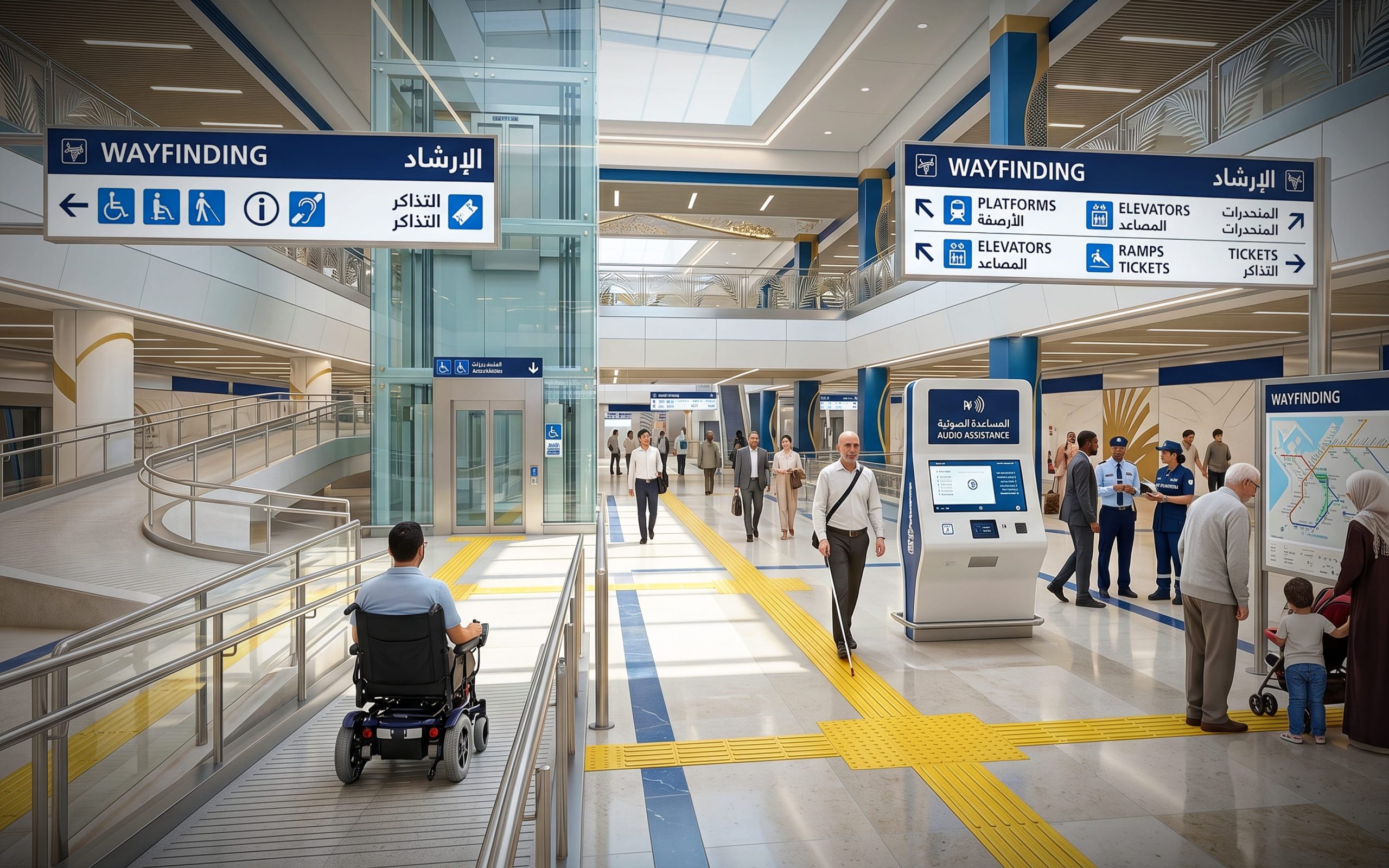
Accessibility & Inclusive Navigation
Understanding how signage systems support accessibility across public buildings.
Introduction (Problem)
One of the biggest failures in the design and implementation of signage systems is the absence of inclusivity.
Too often, signage is designed to satisfy the client, the architect or the visual identity of the project while the actual users of the space are overlooked.
The result is a system that may look visually appealing but fails to serve a diverse range of users.
This becomes critical in large or multi-complex environments, where spaces are used by people of different ages, abilities, cultures, and languages.
If accessibility and inclusivity are not considered from the beginning, they become difficult and often ineffective to implement later.
Core Idea
Accessibility is not a feature. It is a foundation.
A well designed signage and wayfinding system must be built around the needs of all users not just the average user.
When inclusivity is integrated at the early stages of project development, navigation becomes natural, intuitive and independent for everyone.
When it is ignored, signage becomes a reactive tool trying to fix problems that already exist.
The success of a wayfinding system should not be measured by how it looks, but by how many people it serves effectively.
Human Behaviour
People interact with environments differently based on their abilities and conditions:
- Visually impaired users depend on tactile and high contrast information
- Elderly users require clarity, larger fonts and reduced complexity
- International visitors rely on symbols more than language
- First-time users depend on intuitive navigation
Globally, over 2.2 billion people live with some form of vision impairment (WHO, 2026).
This means accessibility is not a niche requirement it affects a significant portion of users in any environment.
A well-designed system recognises these differences and ensures that navigation is not dependent on ability.
System Explanation
An inclusive signage system considers accessibility at every level:
- Larger, legible typography for readability
- High contrast colour combinations for visibility
- Braille and tactile signage for visually impaired users
- Use of universally recognised symbols
- Consistent placement of signage at predictable locations
- Clear and simplified messaging
Accessibility is not achieved through one element it is the result of a coordinated system.
Challenges
- Accessibility introduced too late in the project
- Over-prioritisation of aesthetics over functionality
- Lack of awareness among stakeholders
- Poor execution of tactile and braille elements
- Inconsistent signage placement
- Resistance when accessibility is not a client priority
In many cases, achieving inclusivity requires additional effort when it is not already embedded in the project vision.
Application
Inclusive navigation becomes critical in:
- Healthcare facilities
- Government buildings
- Public infrastructure
- Mixed-use developments
- Cultural and tourism destinations
Our Approach
At RIZQ Group accessibility and inclusivity are treated as essential components of signage and wayfinding systems not optional additions.
Our approach focuses on integrating inclusive design principles from concept to execution, ensuring that navigation systems function effectively for all users.
Where clients prioritise accessibility, implementation becomes seamless. Where it is not initially considered our role is to guide the process and ensure that inclusivity is brought into the system without compromising functionality.
Conclusion
Accessibility and inclusivity are not constraints they are indicators of a well designed environment.
A successful signage system is one that serves every user equally, allowing people to navigate independently, confidently and without barriers.
Start a Project
Have a project that requires accessibility-compliant signage and inclusive navigation?