
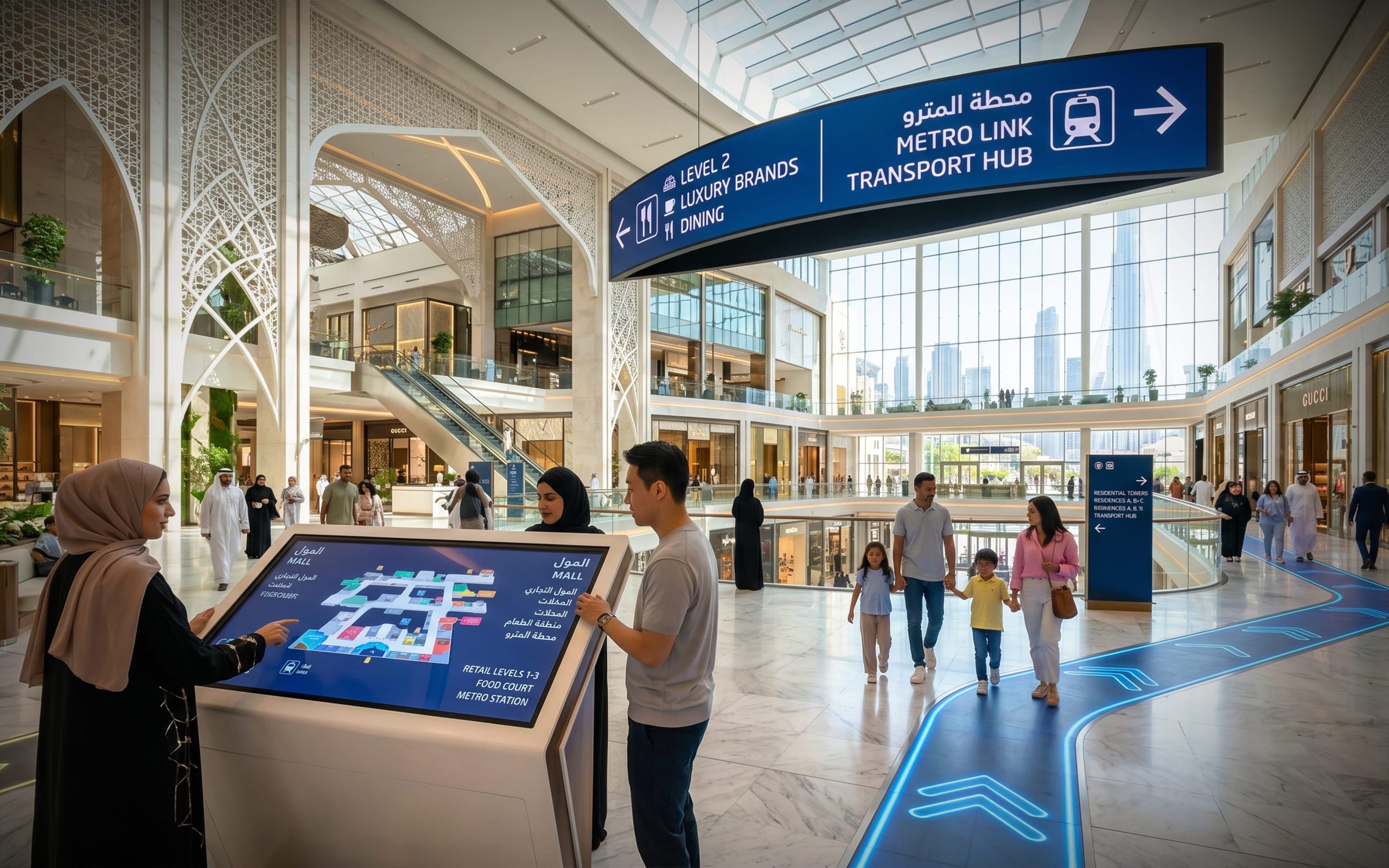
Wayfinding Systems in Large Developments
Designing Navigation Clarity Through Structure, Behaviour and Spatial Logic
Designing Navigation Clarity Through Structure, Behaviour and Spatial Logic. Wayfinding systems in large developments should never be treated as an afterthought.
Designing Navigation Clarity Through Structure, Behaviour and Spatial Logic
Introduction
Wayfinding systems in large developments should never be treated as an afterthought.
When navigation is considered only after construction is complete, signage becomes a reactive layer attempting to solve problems that are already embedded within the environment.
The result is often confusion, over-signage and inconsistent user experience.
In contrast, when wayfinding is integrated during the early stages of planning, it enables seamless navigation. It allows movement, orientation, and decision-making to be built into the environment itself rather than being corrected later through signage.
Wayfinding Begins Before Signage
Wayfinding is not signage. It is a system.
In large developments such as mixed-use environments, campuses, healthcare facilities, or public destinations, navigation is influenced by multiple layers:
- Spatial layout
- Entry and exit points
- Circulation paths
- Visual cues within architecture
When signage and wayfinding specialists are involved early in the project, there is an opportunity to influence these layers. Even small decisions such as corridor alignment, visibility at intersections or placement of vertical circulation can significantly improve navigation outcomes.
This is where wayfinding shifts from being a graphic exercise to a spatial strategy.
Human Navigation Is Instinctive
Human beings are not dependent on signage to navigate.
Through evolution, people have developed natural navigation instincts using visual markers, light, spatial memory and orientation cues to move through environments.
Good wayfinding systems do not replace these instincts; they support and enhance them.
- Follow visible paths
- Move toward light and open spaces
- Use landmarks for orientation
- Prefer simple, predictable routes
A well-designed wayfinding system works with these instincts not against them.
Function Before Aesthetics
One of the most common mistakes in wayfinding is prioritising design over functionality.
A visually attractive signage system that does not guide users effectively has failed its purpose.
Wayfinding must first answer:
- Can users reach their destination without confusion?
- Are decision points clear?
- Is information placed where it is needed—not where it looks good?
Only after functionality is achieved should aesthetics be layered onto the system.
Wayfinding should be approached as a research-driven discipline first, and a design expression second.
Complexity in Large Developments
Large developments introduce unique challenges:
- Multiple user types (visitors, residents, staff, service teams)
- Multiple access points
- Changing tenant environments
- Vertical and horizontal navigation complexity
- Phased development and future expansion
Without a structured wayfinding strategy, these environments become fragmented and difficult to navigate.
A coordinated system ensures:
- Consistent messaging
- Clear hierarchy of information
- Logical movement across zones
The Role of Data and Experience
Today, wayfinding is no longer based on assumptions.
It is informed by:
- User behaviour studies
- Movement patterns
- Sightline analysis
- Real world project experience
Experienced wayfinding designers and consultants bring this knowledge into projects allowing navigation systems to be designed based on how people actually move, not how spaces are drawn.
Collaboration Is Critical
Wayfinding systems cannot be developed in isolation.
They require continuous collaboration between:
- Clients and stakeholders
- Architects and designers
- Project teams and operators
The most important phase of any wayfinding project is information gathering.
This involves:
- Understanding user groups
- Defining movement patterns
- Identifying key destinations
- Aligning with operational requirements
This stage often determines the success or failure of the entire system.
RIZQ Group Approach
At RIZQ Group, wayfinding systems are approached as a structured process rooted in logic, research and execution.
Our role is to translate navigation strategies into coordinated signage systems that function effectively within real-world environments.
Whether working within existing developments or new projects, we apply:
- Experience from diverse project types
- Practical understanding of site conditions
- Coordination across design and execution stages
We also collaborate with global partners and project teams to ensure that navigation systems deliver clarity, consistency, and long-term usability.
Conclusion
Wayfinding systems in large developments are not an add-on they are a fundamental part of how environments function.
When approached correctly, they:
- Improve user experience
- Enhance operational efficiency
- Reduce confusion and dependency on assistance
The success of a wayfinding system lies not in how it looks, but in how naturally it guides people through space.