
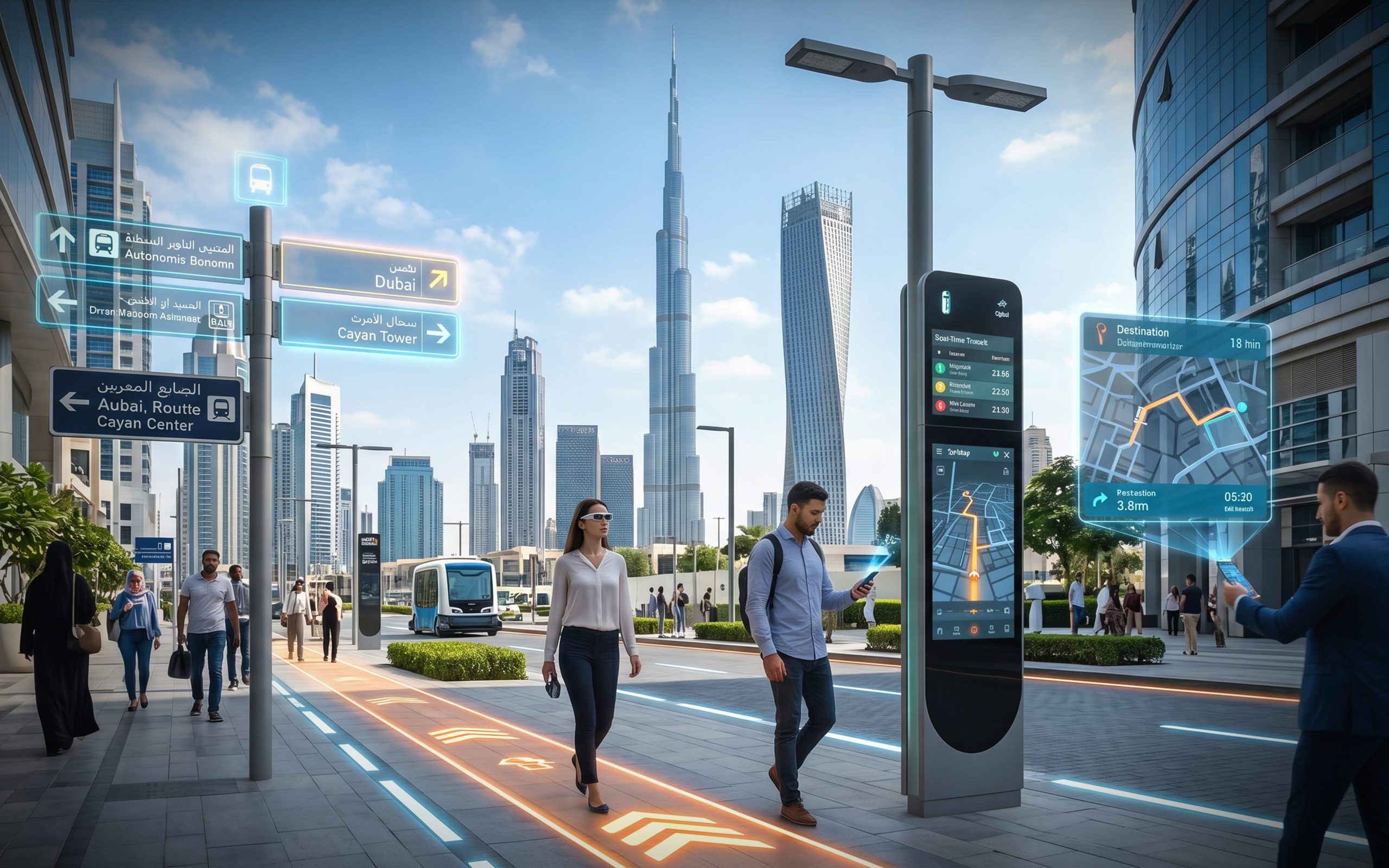
Integrated Spatial Navigation Solutions
Bringing together physical signage, digital systems and spatial design
RIZQ Group provides integrated spatial navigation solutions that improve movement, user experience, and wayfinding across complex environments.
Bringing together physical signage, digital systems and spatial design
Introduction
Navigation in buildings is often treated in parts.
- Signage is designed separately
- Digital systems are added later
- Architecture follows its own logic
The result is a fragmented experience.
Users are forced to depend on multiple systems that don't speak to each other. This creates confusion, even in well designed environments.
Modern buildings are becoming more complex. Treating navigation as separate elements is no longer effective.
Core Idea
Navigation should be treated as one system not multiple layers.
Integrated spatial navigation is about aligning:
- Physical signage
- Digital wayfinding
- Architectural cues
Into a single, coordinated experience.
The goal is simple:
👉 The user should not feel the system it should just work.
Human Behaviour
Users don't think in terms of systems.
They don't differentiate between:
- A sign
- A digital screen
- A corridor layout
They simply expect to move from point A to point B without confusion.
If navigation requires:
- Stopping
- Searching
- Interpreting multiple systems
Then integration has failed.
A good system allows users to move instinctively, without overthinking.
System Explanation
An integrated navigation system typically includes:
- Physical signage providing primary guidance
- Digital systems offering additional and dynamic information
- Architectural design supporting orientation and movement
- Clear hierarchy of information across all systems
- Infrastructure planning for future digital integration
The key is coordination not complexity.
Challenges
- Lack of coordination between consultants and systems
- Digital systems introduced without strategy
- Over-dependence on technology
- Physical and digital systems giving conflicting information
- No long term planning for scalability
Many projects invest in advanced systems but fail in basic integration.
Application
Integrated navigation becomes essential in:
- Airports
- Smart buildings
- Large mixed-use developments
- Healthcare campuses
- Transport hubs
Anywhere scale and complexity increase, integration becomes critical.
RIZQ Group Approach
At RIZQ Group, navigation systems are approached as part of a larger spatial experience.
Our focus is to ensure that:
- Physical signage forms a strong foundation
- Digital systems are aligned not added randomly
- Navigation works as one cohesive system
We work with project teams to ensure that navigation is coordinated from planning through execution.
Conclusion
Integrated spatial navigation is not about adding more systems.
It is about making all systems work together.
When done correctly, users move through environments naturally without needing to think about navigation at all.
Start a Project
Looking to integrate physical and digital navigation systems?