Invisible Wayfinding
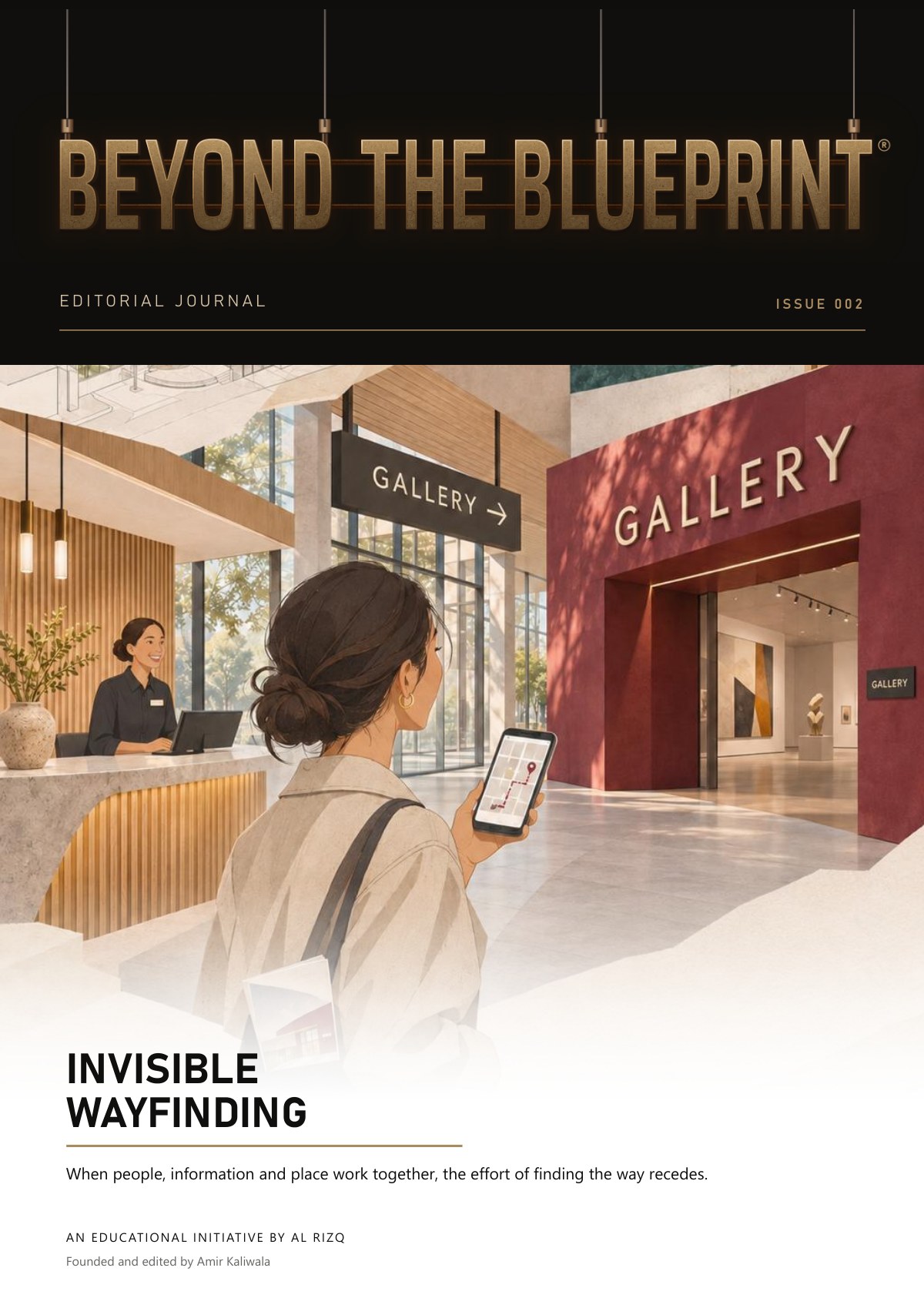
When people, information and place work together, the effort of finding the way recedes.
“The best signage seems to take on an air of invisibility. It is there, but is taken in and taken for granted.”Ivan Chermayeff
In this issue
- 01Invisible Wayfinding
- 02The First-Time Visitor Test
- 03A Practice-Led Question
- 04People Do Not Navigate Alike
- 05The System Behind the Sign
- 06The Journey Begins Before Arrival
- 07One Decision at a Time
- 08How Do We Know It Works?
- 09The Sign Remains Visible
- 10Coming Next
01EditorialInvisible Wayfinding
Wayfinding is often judged by the visible objects, such as signs, directories, maps and markers. But the success of a system is not defined by how little of it the visitor notices. It is defined by whether the system supports the next appropriate decision with clarity and confidence.
A sign can be beautifully integrated and still arrive too late. It can be perfectly legible and still carry the wrong message. It can be technically complete and still leave a first-time visitor asking, Am I going the right way?
Invisible Wayfinding is therefore not invisible signage. The sign remains present and readable. What recedes is the effort required to find, interpret and connect each instruction while moving through an unfamiliar place.
Architecture establishes entrances, thresholds, views, circulation routes and destination cues. Information turns those spatial conditions into explicit choices. People, service and technology help the visitor prepare, confirm and recover. No single element replaces the others.
At each stage, the designer must determine what the visitor needs now, what can wait and what confirms the decision being made is correct. The visitor should not have to understand the entire journey—only the next decision required.
The objective is not to minimise the number of signs. It is to minimise avoidable uncertainty.
Chermayeff quotation source: foreword to Chris Calori and David Vanden-Eynden, Signage and Wayfinding Design, 2nd edition, Wiley, 2015.
02Lessons from PracticeThe First-Time Visitor Test
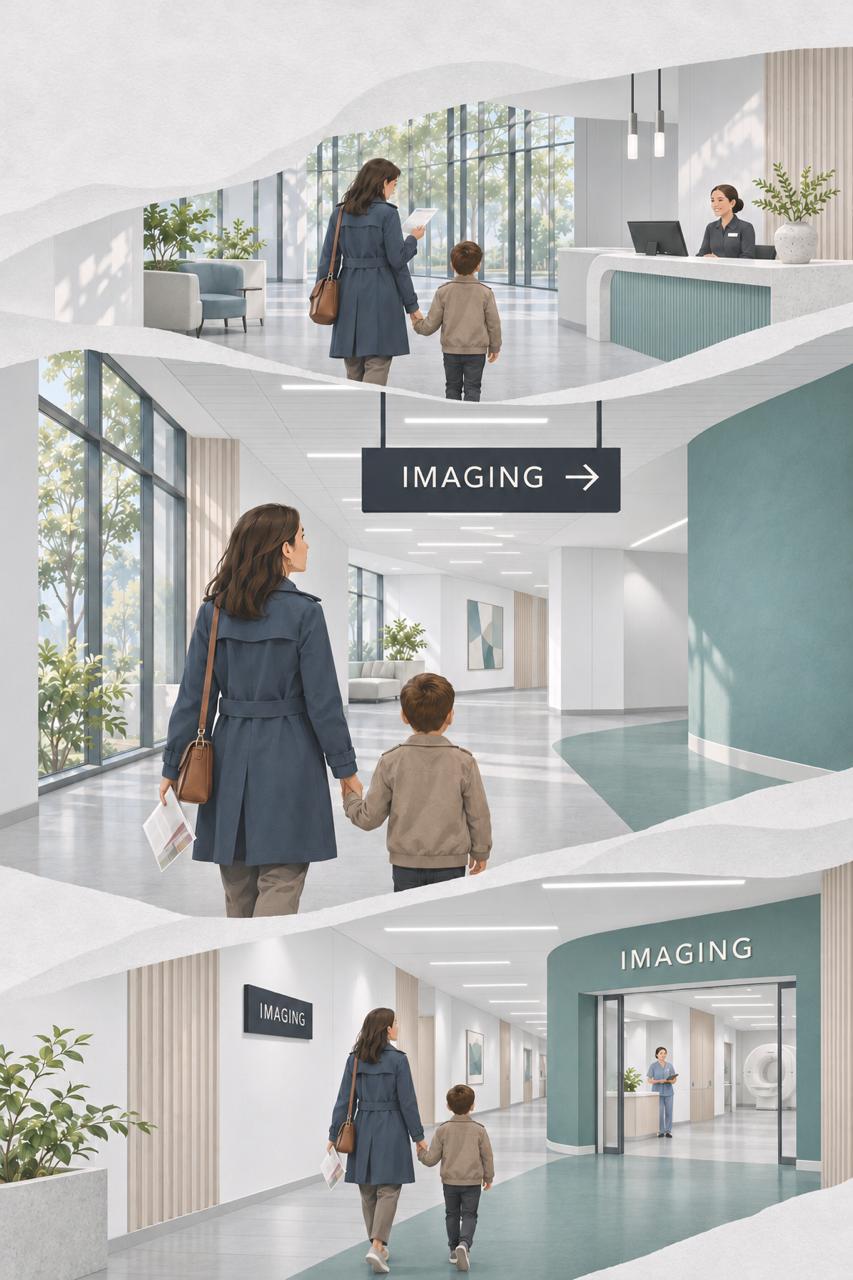
Composite scenario illustrating common first-time visitor conditions.
Observation
A hospital visitor arrives with a child, a bag and concern for someone inside. Their attention is distracted before the journey begins. They may also be thinking in an unfamiliar language, managing limited mobility or a sensory impairment, or rushing to arrive on time.
Challenge
They do not know the building’s logic. Department names, entrance labels, lift banks and corridor codes carry little meaning until the system establishes a hierarchy they can follow.
Design Response
Place the essential message before the choice point. Make the destination, direction and hierarchy readable in motion. After a consequential turn, provide confirmation before uncertainty has time to grow.
Outcome
The visitor can make the next decision with less hesitation. Confirmation supports continued movement, reduces backtracking and provides a point from which the visitor can recover if confidence is lost.
Do not design only for the calm reviewer studying a drawing. Design for the first-time visitor moving under pressure, with limited attention and no prior knowledge of the place.
Reducing avoidable doubt is not an enhancement to the wayfinding journey. It is a condition of success.
03From the EditorA Practice-Led Question
Invisible Wayfinding began with a practice-led question: can signage remain fully present while the effort of navigating recedes from the visitor’s attention? My original proposition focused on information that is precise, timely and legible—information that supports the next decision without making the visitor work to decode it.
My conversation with Dr Colette Jeffrey tested that proposition against research into how people navigate, where uncertainty occurs and what helps them recover when confidence is lost. It strengthened the idea. The objective is not to make signs disappear or promise a journey without uncertainty. It is to reduce avoidable uncertainty, support the next appropriate decision and enable confident recovery.
Beyond the Blueprint was created to bring knowledge that often remains within specialist practice into a wider professional conversation. This issue connects wayfinding thinking with the realities of engineering, fabrication, installation and long-term performance.
“The sign remains visible. What should recede is the visitor’s effort to find, interpret and connect the next instruction.”Amir Kaliwala — Founder and Editor, Beyond the Blueprint

Amir Kaliwala
Founder and Editor, Beyond the Blueprint
Amir Kaliwala is the Founder and Editor of Beyond the Blueprint, a registered educational brand and knowledge-sharing initiative by AL RIZQ. His background spans brand management and more than a decade in signage engineering, fabrication and project delivery. His perspective connects design intent with the practical realities of materials, manufacture, installation and long-term performance. Through Beyond the Blueprint, he invites specialists across the built environment to share knowledge across professional boundaries.
04Research PerspectivePeople Do Not Navigate Alike
Dr Colette Jeffrey’s PhD, Why People Get Lost in Buildings, examined real-world wayfinding and waylosing from the perspectives of building users, design practitioners and academic research. The study considered recalled behaviour from 182 navigators, the expectations of 50 design practitioners and a real-world wayfinding study involving 26 navigators.
A central finding is that people do not approach an unfamiliar journey in one consistent way. Dr Jeffrey’s PARC Navigator typology describes four broad navigation behaviours.
These are not fixed personality types. The same person may change behaviour according to the importance of the destination, familiarity, stress, time pressure, companions or what happens during the journey.
The design implication is clear: a successful system cannot assume that every visitor prepares in advance, notices every sign or navigates independently.
Relies on another person, follows someone or follows a defined route with limited independent checking.
Plans before travelling, checks maps or directions and seeks confirmation throughout the journey.
Makes limited preparation and responds to signs, people and environmental cues encountered on arrival.
Navigates with another person through shared observation, discussion and agreement about the route.

Dr Colette Jeffrey
Dr Colette Jeffrey is a specialist wayfinding consultant and Director at Copper Jetty, an independent design agency specialising in solving complex navigation problems. Associate Professor of Wayfinding and PhD Supervisor at Birmingham City University until 2025, her own PhD explored why people get lost in buildings. She is a Fellow of the Royal Institute of Navigation and is internationally recognised as a leading expert in wayfinding and human navigation, having worked in industry and in academia for over 25 years.
www.copperjetty.comResearch perspective informed by Dr Colette Jeffrey’s PhD, Why People Get Lost in Buildings: Navigator Cognition on Indoor Wayfinding and Waylosing, Birmingham City University, 2019. PARC Navigator and EPIC Navigation were developed by Dr Colette Jeffrey.
05EPIC NavigationThe System Behind the Sign
A sign does not operate in isolation. Dr Jeffrey’s EPIC Navigation framework identifies four major influences on wayfinding and decision making: Environment, People, Information and Cognition.
These influences are usually shaped by different teams. Architects and interior designers shape the environment. Wayfinding and information designers organise communication. Operators and frontline staff influence the service layer. The navigator brings individual ability, experience and purpose.
When the four influences reinforce one another, the journey can feel natural. When they conflict, even a technically correct sign may fail to support the intended decision.
- Environment
Entrances, routes, visibility, landmarks, lifts, stairs, lighting, landscape, colour and the physical logic of the place.
- People
Receptionists, security staff, guides, companions and other people who give directions, provide reassurance or influence route choice.
- Information
Websites, appointment messages, names, maps, signs, symbols, applications and spoken directions encountered before and during the journey.
- Cognition
Attention, memory, assumptions, confidence, stress, previous experience and the visitor’s ability to interpret and connect the available cues.
No single discipline controls the complete wayfinding experience—but one coordinated owner must connect it.
06Before ArrivalThe Journey Begins Before Arrival
A visitor may begin navigating hours or days before reaching the building. They search online for information about the destination, read an appointment message, save a map, identify an entrance and estimate the time required. The information encountered on arrival must confirm what they have already learned.
When the website, map pin, appointment message, receptionist and physical signs use different names or direct people towards different entrances, uncertainty begins before the first on-site decision.
- Appointment
- Website
- Map pin
- Site entrance
- Building or zone
- Lift or floor
- Destination
Progressive disclosure
Progressive disclosure is not simply the removal of messages. It is the disciplined release of information as it becomes relevant.
At the site boundary, the visitor may need only the correct entrance or building. Inside the building they need the correct lift or zone. Detailed department, service or room information becomes useful only when the visitor reaches the appropriate area, or level in the building.
The visitor should not have to understand the entire journey from the start – only the next decision required, supported by confirmation that the previous decision was correct.
Names used online, in appointments, by staff and on signs must remain consistent across all communication, especially when place names change.
07The Decision ChainOne Decision at a Time
A journey is experienced as a sequence of decisions. Each stage should answer one immediate question and guide the visitor confidently to the next.
One connected chain of decisions
- 01OrientWhere am I?
- 02DecideWhich way now?
- 03MoveIs the route continuing clearly?
- 04ConfirmWas that decision correct?
- 05ArriveIs this the intended destination?
When confidence is lost
Even a well-designed journey can contain uncertainty. A missed sign, unexpected closure, misunderstood name or moment of distraction may interrupt the intended route. Recovery must therefore be designed as part of the system.
Message hierarchy
Prioritise what is needed now. Suppress what can wait. Make the essential decision clear.
Functional legibility
Size, contrast, placement, language and viewing distance must work for a person in motion, not only on a drawing.
Confirmation
After every consequential choice, provide reassurance before uncertainty has time to grow.
A successful journey is connected, not necessarily uninterrupted.
08Measuring SuccessHow Do We Know It Works?
A newly installed sign system can look coherent in photographs and still fail the first-time visitor. Success must therefore be observed in the journey, not assumed from the appearance of the installed objects.
In Dr Jeffrey’s research, 66 per cent of indoor respondents who recalled what they did after becoming lost used a people-assisted strategy. This reinforces an operational truth: receptionists, security personnel, guides and other staff are not outside the wayfinding system. They are part of it.
Practical approach
Measure selected indicators before and after an intervention. The purpose is not to turn every project into an academic study, but to show whether the journey improved in ways that matter to the visitor and the operator.
Visitor confidence
Can people identify where they are, make the next decision and confirm that they remain on the correct route?
Behaviour
Where do people hesitate, turn incorrectly, backtrack, abandon a route or stop to search for information?
Requests for help
How often do visitors ask reception, security or other staff for directions, and at which locations?
Operational burden
How much staff time is spent redirecting people or explaining destinations that should be easier to find?
Service performance
Are appointments, boarding processes, visits or other timed activities affected by navigation-related delay?
Inclusion and recovery
Can people with different physical, sensory, cognitive and language needs complete the route or recover through planned support?
Less avoidable uncertainty. Fewer preventable failures. Faster and more confident recovery.
Source: Colette Jeffrey, Why People Get Lost in Buildings: Navigator Cognition on Indoor Wayfinding and Waylosing, PhD thesis, Birmingham City University, 2019.
09In ClosingThe Sign Remains Visible
The sign remains visible.
The effort of navigation recedes.
Invisible Wayfinding does not promise a journey without uncertainty. It reduces avoidable uncertainty, supports the next appropriate decision and helps people recover confidently when uncertainty occurs.
The sign remains visible. The architecture remains visible. Staff, digital tools, landmarks and information remain available. What recedes is the visitor’s need to stop repeatedly, reconstruct the route and question whether the last decision was correct.
When environment, people, information and cognition are considered together, wayfinding becomes more than a collection of signs. It becomes a coordinated journey—one that begins before arrival, reveals information progressively, confirms consequential decisions and remains supportive when the intended route is interrupted.
This issue was developed through an editorial conversation with Dr Colette Jeffrey, specialist wayfinding consultant and Director at Copper Jetty, and with reference to her doctoral research on why people get lost in buildings.
www.copperjetty.comAmir Kaliwala, Founder and Editor, Beyond the Blueprint
An educational initiative by AL RIZQ
10Issue 003Coming Next
Before the Sign
How architecture shapes the wayfinding experience.
Long before a visitor reads a sign, the environment has already begun to guide—or confuse. Entrances, sightlines, lighting, landscape, landmarks, circulation and spatial form influence what people notice, where they expect to move and how confidently they continue.
The next issue explores how the journey is shaped before formal signage appears: how the built environment communicates, where intuitive movement succeeds and when signage is asked to repair a problem that began much earlier.
Subscribe to Beyond the Blueprint on LinkedIn for the next issue and the continuing discussion on design, delivery and the experience between them.
Subscribe on LinkedIn Scan to subscribe
The designed magazine edition. Subscribe to Beyond the Blueprint on LinkedIn for the next issue and the continuing discussion on design, delivery and the experience between them.
When design intent meets operational reality—and the built experience reveals what the drawing could not.